

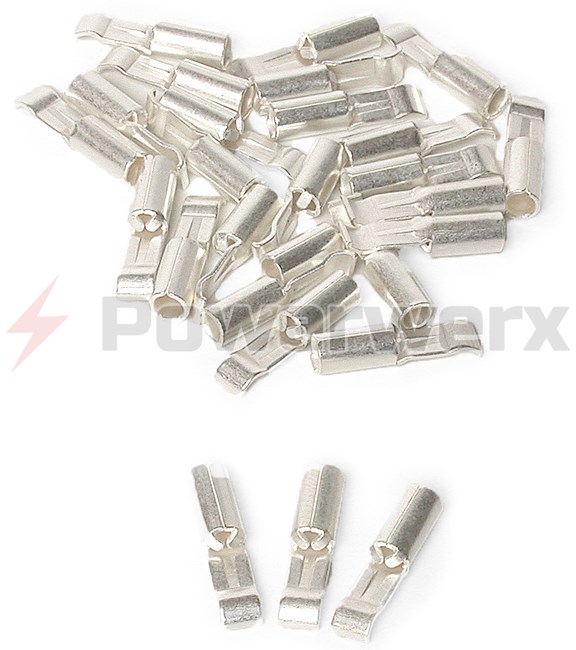
1331-BK Anderson Power PP30 Powerpole Connector Contact, 12-14 GA, 30A, Loose Piece
- $0.25
- In Stock
- SKU: 1331
Customer Reviews
These 30Amps Are All I Use By Powerwerx customer
I only use 30 amp Powerpole contacts no matter what wire size I make. It keeps things simple, though making chords with smaller wire is difficult!
Jeff
Jeff
Was this review helpful? Yes No (3/2)
Excellent performance contacts with lots of uses! By Powerwerx customer
These contacts are, of course, intended to be used with Powerpole housings (although I have used them for other things described below). The contacts make a tight, reliable crimp connection with the wire, easily snap into the housings and have a very low contact resistance (for the 30 amp contacts that I use, I measured across one connection a voltage drop of 1.7 millivolts with a 15 ampere load which equates to 113 micro-ohms per contact). The contacts are silver plated, and naturally wipe against each other to insure a clean and low resistance connection.
The housings have a built in leaf spring which pushes the contacts into their mating position. This means that the contact pressure does not rely on the strength of the terminal, but rather on the housing spring. Therefore, the connections will not loosen with repeated insertion/removal cycles like other connectors do.
These contacts easily snap into the housings and are retained by the little "hook" on the end of the contact and the leaf spring (in the housing) which maintains the contact pressure. The contacts are easily removed from a housing simply by using a jeweler's screwdriver to lift the hook up off the leaf spring, then pull the wire/contact out. There is a tool for removing the contacts, but the jeweler's screwdriver works fine. Your choice.
These contacts have other (unadvertised) uses. The flat part of the contact can be bent into a hook shape and wrapped around a pin (such as the terminal of a large wirewound aluminum body resistor), crimped tight with needlenose pliers and then soldered. The flat part may also be hooked around any large (1/16 to 3/16 inch diameter) pin or wire, crimped and soldered to make a reliable and physically strong high current connection.
To solder the contact and not damage the wire insulation, use either a clip-on heatsink on the round, crimped part of the contact (to keep heat away from the wire's insulation) or use silicone insulated wire. Silicone insulated wire is more expensive, but once you've used it, you'll never go back to PVC!
Speaking of silicone insulated wire, the wire is usually made with MANY strands of very fine wire (over 1000 strands for 10 AWG!) in order to make it super flexible. Since the Powerpole contacts are sized for their intended wire gauge, it is quite difficult to get every strand into the barrel before crimping. Although the contacts ARE properly sized, the fine strands of silicone wire simply refuse to cooperate! I have found that using a hobby knife to "split" the barrel where each side meets (which slightly enlarges the barrel) allows all the finicky wire strands to be inserted. The crimping tool then restores the round shape of the barrel before the crimp is complete. I don't know if this compromises the integrity of the contact, but I have not had any problems.
Note that this is NOT the fault of the contact, but rather it is caused by the super fine strands of the silicone wire not wanting to stay in a tight circle. There is no problem like this with conventional wire which typically has 15 or 20 strands.
In summary, these Powerpole contacts and connector housings are rugged, have excellent electrical performance, are easy to assemble and work with, create highly reliable connections which are naturally polarized (that is, due to their design, it's impossible for a connector pair to be plugged in backwards), the leaf spring feature maintains optimal contact pressure and the mating surfaces are self cleaning due to the fact that they wipe across each other during each plug and unplug cycle. With a little imagination, these contacts can be used to make heavy duty connections to other components and wires.
110% satisfied, and both thumbs up for Anderson Power PP30 Powerpole Connector Contacts!
Was this review helpful? Yes No (14/0)
Write a review of this product and share your opinion with others.